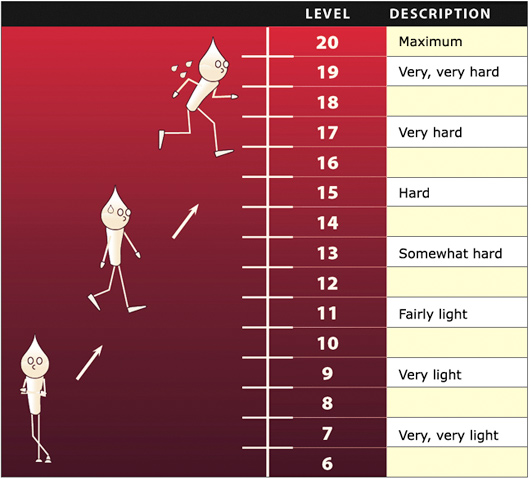
When performing cardiovascular exercises (running, swimming, biking, etc.) it is important to measure your exercise intensity at various points in your workout. The Aerobics and Fitness Association of America recommends measuring intensity at three points during an aerobic workout or group fitness class.
- Five minutes into the workout to determine if you are exercising within your target range.
- At the completion of the most intense portion of your exercise session.
- At the completion of the aerobic cool-down to determine if you have recovered sufficiently.
There are three main ways to measure exercise intensity during aerobic exercise: heart rate, rate of perceived exertion, and the talk test.
Target Heart Rate
Measuring exercise intensity using target heart rate is the most widely used method during aerobic exercise. Using target heart rate will allow you to exercise at a safe and effective level. Working in your target heart rate rate during aerobic exercise will also allow you to use oxygen efficiently and make fitness gains. Exercising at a level underneath your target heart rate will not be sufficient enough to burn maximal calories or attain higher levels of cardiovascular fitness. Meanwhile, exercising above your target heart rate will put you into an anaerobic zone where your body is no longer using oxygen for exercise. This level is ineffective and unsafe for most exercisers especially if maintained for an extended period of time.
Target heart rate is usually represented in percentages of your maximum heart rate. Your working heart rate range should depend on your current fitness level.
- Beginner: 50-60% of maximum heart rate
- Intermediate: 60-70% of maximum heart rate
- Advanced: 75-85% of maximum heart rate
When beginning a fitness program, you should start in the 50-60% range and remain there for 2-3 weeks. At that point if you feel ready to workout at a higher intensity aim for the lower end of the 60-70% range and gradually work your way through the range for approximately the next 6 months. Working in intervals is also a great way to experiment with exercising at a higher intensity. Increase your intensity to a higher level for 1-2 minutes, then return to a lower intensity for 2-3 minutes. Gradually increase your exercise duration at the higher level every week.
Calculating Target Heart Rate
There are multiple ways to calculate your target heart rate. The most commonly used formula and the easiest to calculate is the Historical Formula, while the Karvonen Formula is more accurate because it factors in resting heart rate.
Using the Historical Formula
- Estimate your heart rate max (220 - age)
- Determine your working heart rate range from above (beginner, intermediate or advanced)
- Multiply the bottom number in the range by your maximum heart rate
- Multiply the top number in range by your maximum heart rate
- Your target heart rate range is the answer to #3 - the answer to #4
An Example using the Historical Formula
Determine the working heart rate range for a 22-year old intermediate exerciser
- 220 - 22 = 198
- working heart rate range = 60-70%
- 60% x 198 = 118.8
- 70% x 198 = 138.6
- The exercisers target heart rate range is 118.8 to 138.6 beats per minute
Using the Karvonen Formula
- Determine your resting heart rate *see below*
- Estimate your heart rate max (220 - age)
- Calculate your heart rate reserve (heart rate max - resting heart -ate)
- Determine your working heart rate range from above (beginner, intermediate or advanced)
- Multiply the bottom number in the range by your heart rate reserve, then add your resting heart rate
- Multiply the top number in range by your heart rate reserve, then add your resting heart rate
- Your target heart rate range is the answer to #5 - the answer to #6
An Example using the Karvonen Formula
Determine the wokring heart rate range for a 22 year old intermediate exerciser with a resting heart rate of 70 beats per minute
- Resting heart rate = 70 beats per minute
- 220-22 = 198
- 197-70 = 128
- 60-70%
- (60% x 128) + 70 = 146.8
- (70% x 128) + 70 = 159.6
- The exercisers target heart rate range is 146.8 to 159.6 beats per minute
Determining Your Heart Rate
To check your heart rate, for resting or working, begin by finding your radial artery on the outside of your wrist. Make sure to use your first two fingers (not your thumb) to locate your pulse. Begin with the count of "1" and continue counting the beats for 15 seconds. Multiply this number times 4 to determine your heart rate. When determining your resting heart rate, it is best to check it first thing in the morning before you get out of bed. If this isn't possible, sit quietly for 10 minutes before checking it.
Once you determine your working heart rate, compare this number to your target range. If your target heart rate is within your range, then you're right on track! If the number is below your range, increase the intensity by increasing your speed, incline, or resistance. If the number is below your range decrease the intensity by decreasing your speed, incline, or resistance.
Remember to try to check your heart rate at least 3 times during your workout as I mentioned earlier. Checking your heart rate periodically during aerobic exercise can help to make your workouts more effective and set you on the right path toward meeting your fitness goals. I will post about the other two methods of measuring exercise intensity in the upcoming week.
Sources: AFAA Fitness: Theory & Practice,
Sparkpeople